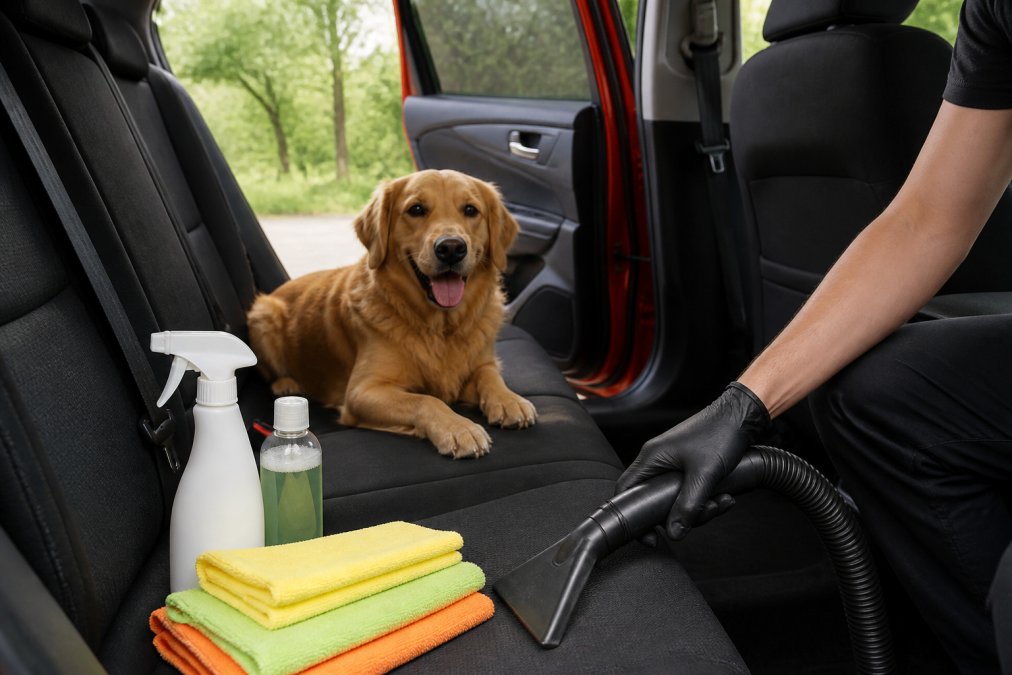
Best Way to Remove Dog Smell From Car Interior
Table of Contents
- Why Dog Smell Sticks to Car Interiors
- What You’ll Need Before You Start
- Step 1: Vacuum and Remove Dog Hair From Car Carpet
- Step 2: Apply the Best Enzyme Cleaner for Car Upholstery
- Step 3: Neutralize Odors With Baking Soda and White Vinegar
- Step 4: Handle Leather and Fabric Seats Differently
- Step 5: Refresh the Cabin Air and Replace the Cabin Air Filter
- When to Book Professional Car Interior Detailing Services
- Frequently Asked Questions
Last Updated: September 26, 2026
Why Dog Smell Sticks to Car Interiors
Dog smell doesn’t sit on your seats, it soaks in. To remove dog smell from car interiors, you need to understand what you’re fighting.
Dander, Oils, and Porous Materials
Dander, the tiny skin flakes dogs shed constantly, carries the proteins behind that distinct “dog” smell, and coat oils and saliva add to the mix.
Spraying air freshener over dog odor makes things worse. The scent mixes with trapped particles and creates a heavier, stale smell that’s harder to remove later.
What You’ll Need Before You Start
Gather your supplies first, stopping mid-job lets odors settle back in:
- A wet/dry vacuum with a crevice tool
- An enzyme-based pet odor eliminator
- Baking soda
- White vinegar
- A spray bottle
- Microfiber cloths
- A stiff-bristle brush or pet hair removal tool
- Rubber gloves
Step 1: Vacuum and Remove Dog Hair From Car Carpet
Vacuuming is the most important step, and it’s the one most people rush. Pet hair removal has to happen before any liquid touches the fabric. Wet hair mats down and becomes nearly impossible to lift.
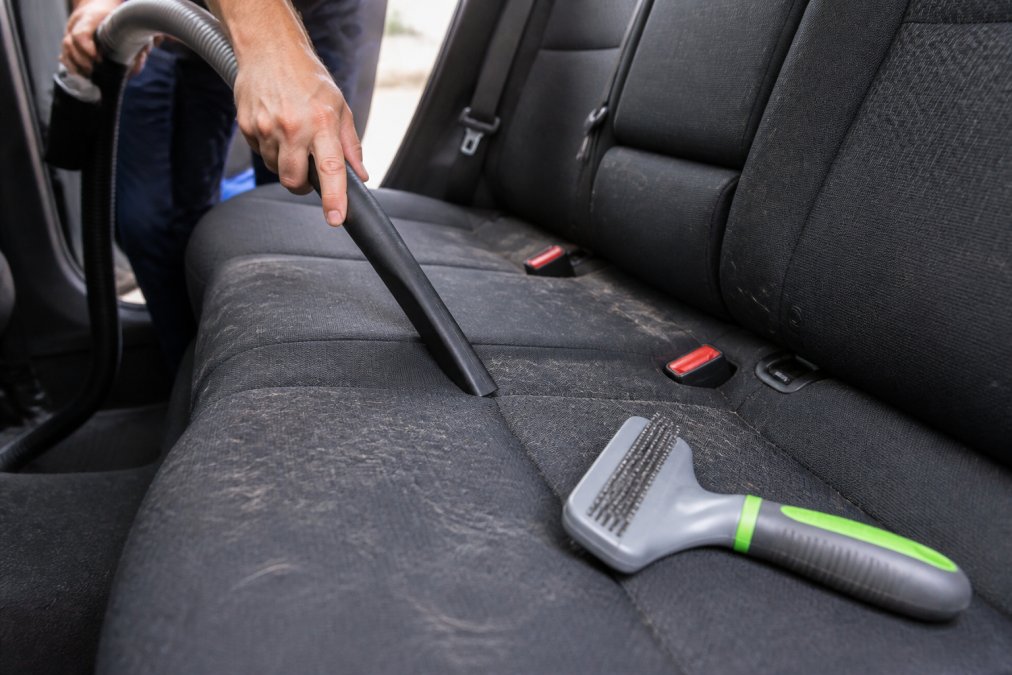
Tools and Techniques for Embedded Hair
Vacuuming in one direction isn’t enough, hair weaves into carpet fibers and needs agitation to release:
- Vacuum the surface first to lift loose hair
- Use a stiff brush to loosen embedded hair from the fibers
- Vacuum again with the crevice tool
- Repeat on floor mats, seats, and trunk areas
- Finish with a rubber-edged squeegee for stubborn patches
Step 2: Apply the Best Enzyme Cleaner for Car Upholstery
The best enzyme cleaner for car upholstery breaks down organic matter at the source, digesting the proteins in dander, saliva, and urine rather than covering the smell.
How Enzymatic Odor Removers Work on Pet Odors
Enzymatic odor removers contain beneficial bacteria that feed on organic waste, breaking down the compounds that produce smell. That’s why they outperform regular fabric sprays: a standard cleaner lifts dirt from the surface, while an enzyme formula goes after the source.
Work in sections instead of spraying the whole interior at once. This lets you keep track of coverage and avoids over-wetting the fabric, which can cause mildew.
Step 3: Neutralize Odors With Baking Soda and White Vinegar
Baking soda and white vinegar are the two most reliable household deodorizers for car interiors. Used together, they pull moisture and trapped odors from porous materials.
Step 4: Handle Leather and Fabric Seats Differently
Most guides tell you to “clean your seats” as if every interior were the same material. It isn’t, and the difference decides whether you remove the odor or ruin the surface.
Why the Two Materials Fail Differently
Fabric is a woven textile over a foam pad, porous at two levels: the fiber itself and the space between fibers. Dander, saliva, and coat oils wick through the weave into the foam, so a surface spray only reaches the top layer.
Fabric Seat Protocol
Work in this order and don’t skip the dwell step, enzymes need contact time to break down dander and saliva proteins.
- Vacuum with a crevice tool, agitate with a stiff brush, and vacuum again. Dry soil has to come out before any liquid goes in.
- Mist an enzyme-based pet odor eliminator evenly, damp to the touch, not wet through.
- Let it dwell for the full time on the label. Most formulas need 10 to 15 minutes; dried urine needs longer.
- Blot with a clean microfiber cloth, working from the outside of the stain inward so you don’t spread the ring.
- If the foam is soaked, use a wet/dry vacuum in extraction mode to pull liquid and suspended soil back out.
- Dry with airflow, not heat, a fan or open doors in shade. Trapped moisture trades a dog smell for a mildew smell.
Leather Seat Protocol
Leather punishes the methods that rescue fabric. Enzyme sprays leave a tacky residue that attracts dust, vinegar dries and cracks the finish, and steam can lift the topcoat on lower-grade leather.
- Vacuum with a soft brush attachment, never drag a crevice tool across leather.
- Wipe with a damp microfiber cloth to lift surface dander and loose oil, rinsing the cloth often.
- Use a pH-neutral automotive leather cleaner, applied to a cloth rather than the seat, working in small sections.
- Pay attention to perforations and stitching, the odor reservoirs. A soft detailing brush works cleaner in without flooding them.
- Wipe dry immediately with a second clean cloth; leather should never be left wet.
- Follow with a leather conditioner to replace the oils the cleaner lifted and prevent cracking.
Perforated and Ventilated Leather
Perforated or ventilated seats are worse than they look: air is pulled through the perforations into the seat’s internal foam and ducting, so dander and oils end up where surface cleaning can’t reach.
Book professional car care today →
What to Avoid on Both Materials
- Bleach, ammonia, and harsh degreasers. They damage fabric dyes and strip leather finish.
- Over-wetting. Saturation is the leading cause of recurring odor because it feeds mildew.
- Scrubbing leather with a stiff brush. You’ll abrade the finish and create a dull patch that never matches the rest of the seat.
- Mixing cleaners. Vinegar followed immediately by an alkaline cleaner neutralizes both.
Test any new cleaner on a hidden area first, under the seat, or the back edge of the cushion. Wait for it to dry fully before committing to the whole seat. Some leather finishes discolor within minutes; some fabric dyes bleed only after they dry.
The material decides the method. Get that right and the odor has nowhere left to hide.
Step 5: Refresh the Cabin Air and Replace the Cabin Air Filter
If the car still smells like a wet dog the moment you turn on the AC, the odor isn’t in your upholstery, it’s in the HVAC system, and no amount of baking soda on the carpet will fix it. This is the step most guides skip, and the reason many DIY cleanups fail.
How the Cabin Air System Traps Dog Odor
Your climate system pulls air through a cabin air filter, across the evaporator core, and out the vents, and every dog ride sends dander, saliva particles, and coat oils through it.
Diagnosing Where the Smell Actually Lives
Before buying a filter, figure out which problem you have. The test takes two minutes.
- Park the car, close the doors and windows, and let it sit an hour so the cabin air settles.
- Get in and smell the air without turning anything on. If it smells, the source is upholstery, carpet, or foam.
- Turn the fan on high with the AC off and windows closed. If the smell strengthens, the source is the filter or ducting.
- Turn the AC on for a minute. A musty, sour note at startup that fades points to the evaporator core.
Replacing the Cabin Air Filter
Most cabin air filters are rated for replacement every 15,000 to 30,000 miles, or roughly once a year. With a shedding dog aboard, replace every 6 to 12 months, sooner if you see visible hair or debris on the pleats.
Cleaning the Evaporator and Ducting
A new filter alone won’t fix a contaminated evaporator. You have two options.
Air Circulation and Ventilation
- Crack a window when your dog is in the car, even a small gap keeps air moving.
- Use fresh-air mode instead of recirculate when the dog is aboard, unless you’re in heavy traffic or extreme heat.
- After a dog ride, air the car out before parking in a closed garage.
- Don’t leave damp towels, dog beds, or wet gear in the car, they re-seed the odor you just removed.
If your car still smells after a full interior clean, the cabin air filter and evaporator core are the usual reason. Test the vents before you re-clean the seats, you may be cleaning the wrong part of the car.
A clean cabin air system makes the rest of your work last. Skip it and the odor comes back the first hot day you run the AC.
When to Book Professional Car Interior Detailing Services
Some odors go deeper than DIY methods can reach. If you’ve vacuumed, sprayed, and scrubbed and the smell persists, the source is likely in the carpet padding or seat foam.
Signs it’s time to call a pro:
- The smell returns within days of cleaning
- You’ve cleaned the same spot three or more times
- Odor is coming from the vents even after a filter change
- Your dog had an accident that soaked into the seat
| Situation | DIY Fix | Pro Service |
|---|---|---|
| Light dog odor, recent | Vacuum and enzyme spray | Not needed |
| Odor returns after cleaning | Baking soda overnight | Recommended |
| Accident soaked into foam | Surface cleaning only | Extraction required |
| Odor from vents | Filter replacement | Full HVAC cleanout |
| Persistent smell after 3 tries | Won’t resolve | Book a detail |
Frequently Asked Questions
What actually cancels out dog smell in a car?
Enzymatic cleaners break down the organic proteins in dander, saliva, and urine that cause the smell. Baking soda absorbs trapped odors from porous materials like fabric seats and carpet. White vinegar neutralizes odors on contact. For best results, vacuum first, then apply an enzyme cleaner, let it dry, and follow with baking soda overnight. This combination removes the source rather than masking it with an air freshener.
Does baking soda really remove dog smell from upholstery?
Baking soda absorbs moisture and trapped odors from fabric surfaces, making it effective for mild to moderate smells. Sprinkle it generously over dry seats and carpet, let it sit for several hours or overnight, then vacuum thoroughly. It works best as a follow-up step after vacuuming and enzyme treatment. For deep-set odors soaked into foam padding, baking soda alone will not reach the source.
How do you get deep-seated dog smell out of fabric car seats?
Deep-set odors require more than surface cleaning. Start by vacuuming with a high-suction wet/dry vacuum to pull out dander and hair. Apply an enzyme cleaner designed for car upholstery, agitate it into the fabric with a microfiber cloth, and let it dwell. For severe cases, professional detailing services can reach foam padding where odors settle. Repeat the enzyme treatment if the smell returns after drying.
How often should you deep clean your car to prevent dog smell buildup?
If your dog rides in the car weekly, vacuum the seats and carpet every two to four weeks and do a full deep clean with enzyme cleaner every two to three months. Daily riders need more frequent attention. Use seat covers to create a barrier, replace your cabin air filter every 12,000 to 15,000 miles, and keep a charcoal air purifying bag in the cabin between cleanings to absorb lingering odors.
Comments are closed.