Why Professional Detailing Beats Hand Washing
Table of Contents
- Hand Washing vs. Professional Detailing: What the Difference Actually Means
- The Hidden Risks of Hand Washing Your Car at Home
- Preventing Swirl Marks on Car Paint: What DIY Washing Gets Wrong
- Benefits of Clay Bar Treatment and Paint Decontamination
- How to Clean Car Interior Professionally (and Why Hand Washing Falls Short)
- Long-Term Paint Protection and Resale Value: The Financial Case for Professional Detailing
- Frequently Asked Questions
Last Updated: September 28, 2026
Hand Washing vs. Professional Detailing: What the Difference Actually Means
Professional detailing is better than hand washing because it restores and protects your vehicle’s finish rather than just removing surface dirt. A hand wash cleans what you can see. A professional detail addresses what you can’t: bonded contaminants, oxidation, and microscopic damage that dulls paint over time.
Here’s the core problem. A driveway wash removes loose dirt from the top layer of your paint. It does nothing about surface contaminants that bond to the clear coat, and it does nothing to replace the protection that washing strips away.
The difference shows up in three places: how the paint looks, how long it lasts, and what your car is worth when you sell it.
The Hidden Risks of Hand Washing Your Car at Home
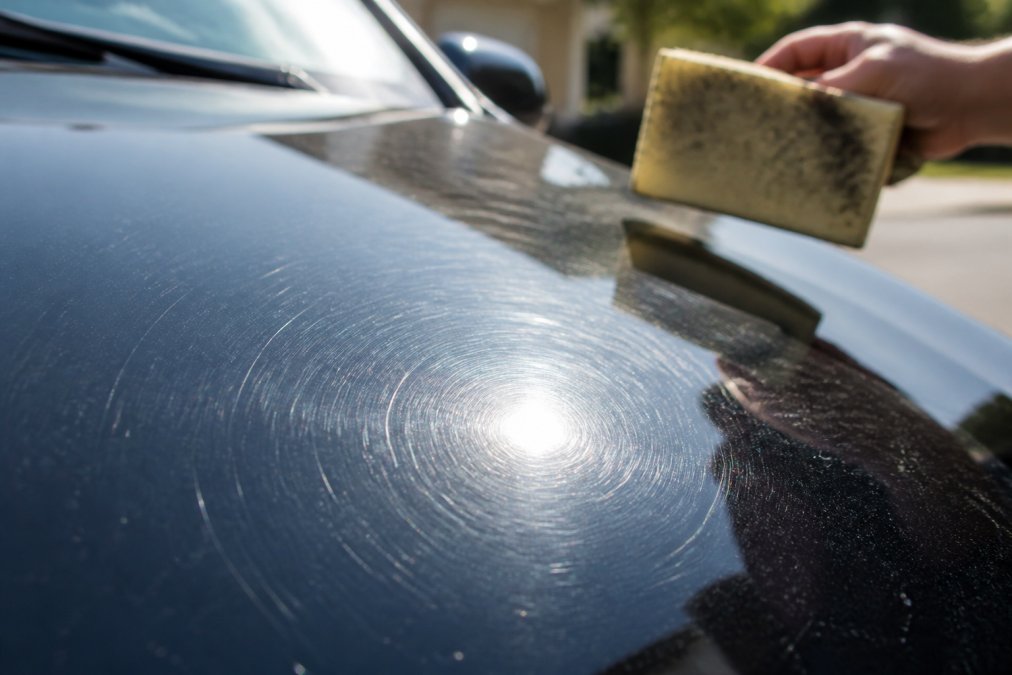
The biggest risk isn’t the soap. It’s the mechanical action of dragging a sponge across a dry or gritty surface. Every pass grinds particles into the clear coat like fine sandpaper.
Three problems show up repeatedly in DIY washes:
- Not enough lubrication. A single bucket of soapy water becomes a grit slurry by the time you reach the rear panels.
- Contaminated tools. A dropped sponge or a reused microfiber towel picks up grit and holds it.
- Direct sunlight. Soap dries before you rinse, leaving residue and water spots that etch into the surface.
Washing in direct sunlight is one of the most common causes of water spots. The soap and minerals dry before you can rinse them, and the residue can etch into the clear coat within minutes. Work in shade, and dry panel by panel.
Why Automatic Car Washes Make It Worse
Automatic washes trade one problem for another. Abrasive brushes and stiff cloth strips slap against your paint at speed, and the same material touches hundreds of cars before yours.
Even touchless systems rely on harsh chemicals to compensate for the lack of friction. Those chemicals strip wax and sealant faster than a pH-balanced soap would, leaving your paint unprotected.
Preventing Swirl Marks on Car Paint: What DIY Washing Gets Wrong
Swirl marks are fine circular scratches in the clear coat, and they’re the single clearest sign of a bad wash technique. They appear because grit gets trapped between your wash media and the paint, then dragged in circles.
The two-bucket method helps. One bucket holds soap, the other holds rinse water, and you clean your mitt between passes. But it only works if you also use a grit guard, fresh microfiber towels, and enough lubrication.
What most guides miss is that technique alone can’t fix an already-contaminated surface. If your paint has bonded surface contaminants, every wash drags them across the finish. That’s why paint decontamination has to come before correction, not after.
| DIY Mistake | What It Causes | Professional Fix |
|---|---|---|
| Single-bucket wash | Grit dragged across paint | Two-bucket method with grit guards |
| Reusing dirty towels | Swirl marks, surface marring | Fresh microfiber per panel |
| Washing in sun | Water spots, etching | Shade washing, panel-by-panel drying |
| Skipping decontamination | Bonded grit under wax | Clay bar treatment, then sealant |
Benefits of Clay Bar Treatment and Paint Decontamination
Clay bar treatment removes bonded contaminants that washing cannot lift: industrial fallout, tree sap, bug residue, and the fine metallic particles that embed in your clear coat. A detailing clay bar pulls these out without scratching, but only when used with proper lubricant and light pressure.
The benefits of clay bar treatment go beyond smoothness. Paint that’s free of contaminants accepts sealant application and ceramic coating far more evenly, which means protection lasts longer and looks better.
Book professional car care today →
This matters for anyone dealing with stubborn bug splatter or red clay buildup. Those deposits bake onto the surface and won’t come off with soap. They need a dedicated decontamination step.
Run your hand over a clean, dry panel inside a plastic bag. If it feels gritty rather than glass-smooth, the paint has bonded contaminants and needs clay bar treatment before any wax or sealant goes on.
How to Clean Car Interior Professionally (and Why Hand Washing Falls Short)
Knowing how to clean car interior professionally starts with understanding that interiors aren’t a dirt problem, they’re a chemistry problem. Exterior washing removes loose and bonded contamination from a hard, sealed surface. Interiors are a mix of porous fabric, coated leather, soft-touch plastic, vinyl, glass, and electronics, and each material reacts differently to the same cleaner. A product that safely lifts grease off a plastic dash can bleach a leather seat or leave a sticky residue on a touchscreen.
That’s why professional interior work is sequenced, not scrubbed. A typical detail moves through these stages:
- Dry extraction first. Loose debris, sand, crumbs, and pet hair come out with a vacuum and soft brush before any liquid touches the surface. Adding water to dry grit just drives it deeper into fabric fibers.
- Targeted pre-treatment. Stains, spills, and sticky residue get a dedicated pre-treatment matched to the soil type, protein-based stains, oil-based stains, and tannin stains (coffee, tea) each respond to different chemistry.
- Agitation with the right tool. Soft boar’s-hair brushes for vents and seams, upholstery brushes for carpet, and microfiber applicators for leather. Stiff brushes on leather or coated plastic leave permanent scratches.
- Hot-water extraction. A heated extractor injects cleaning solution into fabric and immediately vacuums it back out, pulling embedded dirt and moisture with it. This is the step a spray bottle and rag can’t replicate, residue left behind in fabric actually attracts new dirt faster.
- Leather cleaning and conditioning. Leather is skin. It needs a pH-appropriate cleaner that won’t strip its factory coating, followed by a conditioner that replaces the oils UV and heat pull out. Skip the conditioner and the leather dries, cracks, and fades.
- Glass and screen finishing. Interior glass builds a film of plasticizer off-gassing and nicotine-like residue that ordinary glass cleaner smears around. A dedicated interior glass process with two towels, one to clean, one to buff, is what actually gets it clear.
A driveway wash rarely touches any of this. A hose and a bucket clean the outside and leave the cabin untouched, which is why vehicles that are washed weekly still smell stale and show worn seats. The exterior looks maintained; the interior tells a different story the moment a passenger sits down.
Run a clean white microfiber towel across the dash and door panels. If it comes back gray or brown, the interior has a film of embedded soil that a quick wipe won’t remove, it needs a proper deep clean with agitation and extraction.
Interior detailing also protects value in a way exterior washing can’t. Cracked leather, faded plastic, and set-in odors are expensive to reverse and immediately visible to a buyer. Keeping them from starting is the cheap part.
Long-Term Paint Protection and Resale Value: The Financial Case for Professional Detailing
Paint oxidation is the slow killer. Clear coat is a thin, sacrificial layer of polymer that absorbs UV, acid rain, bird droppings, and industrial fallout so the base coat underneath doesn’t have to. Left unprotected, that layer cross-links and breaks down under UV exposure, and the finish turns chalky and dull. Once oxidation reaches the base coat, no wash will bring it back.
Here’s the mechanism, step by step:
- UV and oxidation dull the clear coat, which lowers perceived condition even when the paint is structurally fine.
- Bonded contaminants (industrial fallout, rail dust, tree sap) etch into the surface and can’t be washed off, so they keep damaging until decontaminated.
- Swirl marks and marring scatter light instead of reflecting it, which reads as “neglected” under showroom or dealer lighting.
- Interior wear, cracked leather, stained carpets, stale odors, signals the same thing to a buyer sitting inside the car.
- Maintenance washes every two to four weeks using a pH-neutral, lubricated soap.
- Decontamination and protection every three to six months, clay bar or chemical decon, then sealant or coating topper.
- Full detail with light correction annually, or sooner if you notice new swirls, water spot etching, or loss of gloss.
Think of detailing as automotive maintenance, not cosmetic upkeep. Regular protection prevents the oxidation and contamination that eventually require expensive paint correction. Prevention is always cheaper than restoration, and the resale value it protects is the part you actually get paid back for.
Pricing for professional detailing depends on vehicle size, condition, and the services you choose. Clean Image 101 provides quotes based on your specific vehicle, so you know exactly what you’re getting before we start.
Frequently Asked Questions
Is professional detailing worth the cost for daily drivers?
Yes, for daily drivers, professional detailing protects your investment. Regular hand washing can introduce swirl marks and fail to remove bonded contaminants. Professional detailing uses clay bar treatment, pH-balanced soap, and sealant application to preserve paint integrity. This prevents costly paint correction later and maintains resale value. For busy professionals, mobile detailing also saves time without sacrificing quality.
How does professional detailing prevent swirl marks compared to hand washing?
Professionals use the two-bucket method, grit guards, and clean microfiber towels to minimize mechanical action on paint. They also assess paint condition and choose safe wash methods. Hand washing often reuses dirty water and sponges, dragging abrasive particles across the clear coat. Professional detailers also apply protective wax or ceramic coating, which adds a sacrificial layer that reduces future marring.
What specialized tools do professional detailers use that DIYers lack?
Professional detailers use foam cannons for pre-soak, clay bars for paint decontamination, dual-action polishers for paint correction, and extractors for upholstery extraction. They also have pH-balanced chemicals tailored to specific surfaces. These tools, combined with training, allow them to clean deeply without damaging the automotive finish. DIYers typically lack access to these professional-grade supplies and the expertise to use them safely.
How long should a full detail take?
A full professional detail typically takes 4 to 8 hours, depending on vehicle size and condition. This includes exterior hand wash, clay bar treatment, paint correction if needed, sealant application, interior deep cleaning, and upholstery extraction. Hand washing alone might take 30 minutes but leaves contaminants behind. The extra time invested in professional detailing delivers lasting protection and a showroom-quality finish.
Comments are closed.