How to Maintain Car Paint Finish: Ultimate 2026 Guide
Table of Contents
- How Often to Wash Car to Protect the Finish
- Choosing the Right Car Shampoo and Washing Technique
- The Benefits of Clay Bar Treatment for Paint Contaminants
- How to Remove Bird Droppings from Car Paint Safely
- Wax, Sealant, or Ceramic Coating: Which Paint Protection Lasts
- Seasonal Car Paint Maintenance and Water Quality Basics
- Common Mistakes That Damage Car Paint Finish
- Frequently Asked Questions
Last Updated: September 13, 2026
How Often to Wash Car to Protect the Finish
Washing your car every two weeks is the baseline for protecting modern paint, though the right interval depends on where you park and what you drive through. This guide from Clean Image 101 breaks down how to maintain car paint finish so it holds its gloss for years. A car paint finish is the factory multi-layer coating system: primer, base coat, and a clear coat that shields color from sun, rain, and road debris. When that clear coat degrades, nothing underneath can be saved.
Skipping washes for months lets contaminants bond to the clear coat. Once bonded, they require polishing or paint correction to remove, not soap and water.
Adjust frequency for conditions:
- Weekly: coastal salt air, daily highway commuting, or parking under trees
- Every two weeks: standard suburban driving with garage parking
- After every event: bird droppings, bug splatter, tree sap, or a rainstorm that leaves residue
Southern California sun is unforgiving: UV rays break down clear coat polymers, and dirt left on the surface accelerates that breakdown by trapping heat (the EPA).
Choosing the Right Car Shampoo and Washing Technique
A pH-neutral shampoo paired with the two-bucket method is the safest combination for any automotive finish. Dish soaps strip wax and sealant, leaving paint exposed; a dedicated car shampoo cleans without removing protection.
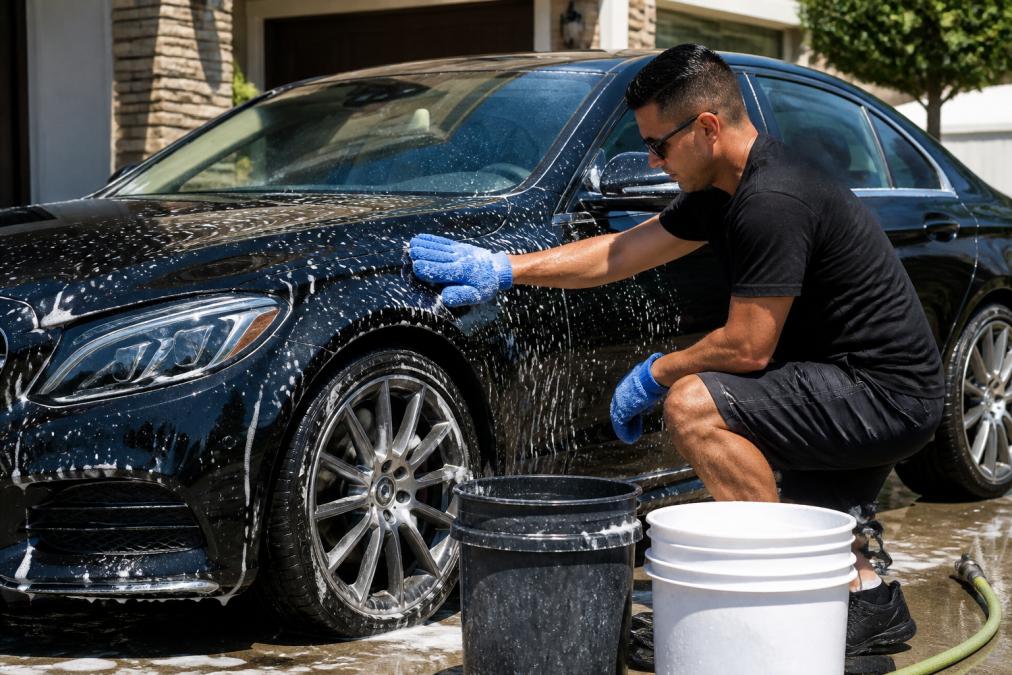
The two-bucket method works like this:
- Fill one bucket with clean shampoo solution and one with plain rinse water
- Load a microfiber mitt, wash one panel, then rinse the mitt in the clean water bucket
- Reload from the soap bucket and continue, panel by panel
- Rinse the whole car top-down before it dries
- Dry with a clean microfiber drying towel, not a chamois or bath towel
A common mistake is washing in direct sunlight. The soap dries mid-panel and leaves streaks that look like surface defects. Work in shade, and wash the roof and upper panels first so dirty water runs onto areas you haven’t cleaned yet.
The Benefits of Clay Bar Treatment for Paint Contaminants
Clay separates a clean car from a smooth one. Washing removes loose dirt but leaves bonded contaminants, industrial fallout, rail dust, brake dust, overspray, airborne metal particles, embedded in the clear coat. A clay bar shears those particles off rather than dissolving them.
The test is simple. After washing and drying, slide your fingertips across a panel, then across the inside of a clean plastic sandwich bag laid over the same panel. The bag amplifies friction, so grit you cannot feel with bare skin becomes obvious. If it drags, the paint needs claying.
Removing these embedded contaminants creates a pristine surface that reveals every minor imperfection, making it the ideal time to address any bodywork issues through paintless dent repair.
Mechanical vs. chemical decontamination
Most modern workflows split this into two stages, and order matters:
- Chemical decontamination first. An iron remover, a spray that turns purple as it dissolves ferrous particles, breaks down embedded brake dust and rail dust. It does the heavy lifting so the clay has less to shear off.
- Mechanical decontamination second. The clay bar (or a clay mitt, clay towel, or synthetic clay block) removes what the iron remover loosened and what it could not reach, including tree sap residue and overspray.
Skipping the iron remover means the clay bar is dragging sharp metal particles across the clear coat. That is how claying creates the swirl marks it is supposed to prevent.
Never clay a panel that has not been washed and chemically decontaminated. Clay picks up whatever is on the surface and holds it against the paint.
Clay grades and how to choose one
Clay is sold by aggressiveness, fine, medium, or heavy. Use the least aggressive grade that removes the contamination:
- Fine grade: For well-maintained paint that only feels slightly rough. Lowest marring risk.
- Medium grade: For daily drivers with noticeable bonded fallout. The common default.
- Heavy grade: For neglected paint, overspray, or industrial fallout. Highest marring risk and should be followed by polishing.
Synthetic alternatives, clay mitts, towels, and blocks, work faster and can be rinsed and reused, but tend to be more aggressive. On soft paint, a traditional fine-grade bar with plenty of lubricant is safer.
Lubrication and technique
Clay needs a dedicated clay lubricant or soapy water mix. Detailer spray alone is not enough on a dry panel; the bar will grab and mar.
Work in sections no larger than two feet by two feet:
- Mist the panel generously with lubricant.
- Glide the clay back and forth with light pressure, let the bar do the work, not your arm.
- Wipe the residue with a clean microfiber towel and check the surface with the bag test.
- Fold and knead the bar frequently so a clean face is always against the paint.
- Drop the bar on the ground? Throw it away. It will never be clean again.
Expect 45 to 90 minutes for a full-size vehicle. Clay also strips any wax or sealant, leaving the paint bare.
After claying, apply a paint sealant or ceramic spray coating within the same session. Bare clear coat has no UV or contaminant defense.
What clay does not fix
Clay removes contamination, not defects. It will not remove swirl marks, scratches, oxidation, or water spot etching that has eaten into the clear coat, those require polishing or paint correction.
How to Remove Bird Droppings from Car Paint Safely
To remove bird droppings from car paint safely, soak the spot with a damp microfiber towel for several minutes, then lift it away without rubbing. Droppings are acidic and begin etching the clear coat within hours in warm weather; scraping them off dry grinds grit into the paint.
The process:
- Lay a soaked microfiber towel over the dropping and let it sit for five minutes
- Lift the towel straight up. Do not wipe
- Re-soak and repeat until the residue releases
- Follow with a quick-detail spray and a fresh towel
- Reapply wax or sealant to that panel
Tree sap responds to the same technique, though it often needs a dedicated sap remover. For baked-on bug splatter on a front bumper, a pre-soak product breaks down proteins before you touch the paint. Clean Image 101 brings professional mobile car wash and auto detailing to your location, with services including expert bug removal and clay bar treatments.
Wax, Sealant, or Ceramic Coating: Which Paint Protection Lasts
Ceramic coating outlasts both wax and paint sealant by a wide margin, but it costs more and requires more careful application. The right choice depends on how long you plan to keep the vehicle and how much upkeep you want.
| Protection Type | Typical Durability | Best For | Upkeep |
|---|---|---|---|
| Automotive wax | Weeks | Enthusiasts who enjoy monthly detailing | Reapply often |
| Paint sealant | Several months | Daily drivers wanting low maintenance | Reapply twice yearly |
| Ceramic coating | Years | Long-term owners, luxury vehicles | Periodic inspection |
Wax gives the warmest shine and is the most forgiving to apply. Sealant is a synthetic polymer that bonds to the clear coat and shrugs off UV and fallout longer. Ceramic coating forms a semi-permanent hydrophobic layer that makes washing easier, but it locks in existing surface defects, so paint correction should come first.
Book professional car care today →
For most drivers who want protection without a monthly ritual, sealant is the sensible middle ground. For a vehicle you intend to keep, ceramic coating pays off.
Seasonal Car Paint Maintenance and Water Quality Basics
Water quality is the most underrated variable in paint care. Tap water carries dissolved minerals, calcium and magnesium in hard water areas, plus chlorine and trace iron, and when a droplet evaporates on a hot panel, those minerals stay behind as a water spot. Given enough time and heat, the deposit etches into the clear coat, and etched spots must be polished out.
The fix is straightforward:
- Dry immediately. Do not let the car air-dry, especially in sun. A blower or a large plush microfiber drying towel removes the water before minerals can concentrate.
- Use a final rinse with filtered or deionized water. A deionized water filter or spot-free rinse system removes the minerals before the water touches the paint, so the panel can air-dry without spotting.
- Wash in shade and in sections. Water that sits on a hot panel evaporates faster and leaves heavier deposits.
- Treat existing spots with a dedicated water spot remover, an acidic gel or spray formulated for clear coat, before they become permanent. Do not use household vinegar on a full panel; it can strip protection and is hard to control.
Hard water spots that have been on the paint for weeks or months are usually etched, not deposited. No wash or spray will remove them, only polishing will.
Seasonal maintenance schedule
Threats to your clear coat change with the calendar, and so should your routine. Adjust this baseline for your climate and storage.
Spring
- Pollen is abrasive and acidic. Rinse the car before washing so you are not dragging pollen grit across the paint.
- Tree sap peaks as temperatures rise. Remove it with a dedicated sap remover or isopropyl alcohol on a microfiber towel, then reapply protection to that panel.
- Clay bar or use a clay mitt once pollen season ends to strip the film that has built up.
Summer
- UV is the primary enemy. Clear coat polymers break down under sustained UV exposure, which is what causes fading and oxidation.
- Keep wax or sealant fresh. A wax that normally lasts weeks may need reapplication sooner in intense sun.
- Park in shade or use a fitted cover. Morning shade is better than afternoon shade because it avoids the heat-soak that bakes contaminants into the paint.
- Wash more often if you park under trees; sap and bird droppings are at their worst in warm months.
Fall
- Falling leaves trap moisture against horizontal surfaces, hood, roof, trunk, and can stain if left wet for days.
- Clear debris from the cowl, window channels, and any panel gaps where leaves collect and hold water.
- This is the ideal window to apply a durable sealant or ceramic spray coating before winter.
Winter
- Road salt and brine are the biggest threats. They accumulate on lower panels, wheel arches, and the undercarriage.
- Rinse the undercarriage and lower panels frequently, ideally with a touchless wash or a pressure washer, when temperatures allow.
- Do not wash with hot water on a cold panel; thermal shock can crack clear coat. Use ambient-temperature water.
- Keep a spray wax or rinse-off sealant in the routine to reinforce protection between full washes.
Parking strategy compounds over years
A garage or covered space eliminates most UV, droppings, and sap at once. When you must park outside:
- Avoid directly under trees. Sap, droppings, and falling debris all land on the paint.
- Choose morning shade over afternoon shade. Afternoon sun is more intense and heats the panel more.
- Do not park near sprinklers. Overspray leaves mineral deposits that etch as they dry.
- On street parking, favor the side away from the curb where irrigation runoff is less likely to reach the paint.
Water quality, drying technique, and parking choices compound over years. Filtered final rinses, immediate drying, and shade parking do more for long-term gloss than any single product.
Common Mistakes That Damage Car Paint Finish
The biggest mistake is treating paint like a hard surface. Clear coat is a thin polymer layer measured in microns, and every abrasive action removes some of it permanently.
Mistakes to stop making:
- Using dish soap or household detergent, which strips protection
- Washing with a sponge or an old rag that traps grit against the paint
- Wiping bird droppings or bug splatter off dry
- Skipping the rinse bucket and grinding dirt back into the surface
- Letting hard water air-dry on the paint
- Polishing aggressively instead of using the least abrasive method that works
Swirl marks are the visible result: fine circular scratches that dull the finish under direct light. Once clear coat is thinned enough, no wax or sealant restores the gloss. Paint correction can, but it removes more clear coat, and there is a limit to how often that can be done.
Prevention costs far less than correction. A pH-neutral shampoo, a microfiber mitt, the two-bucket method, and regular wax or sealant will keep a finish healthy for the life of the vehicle.
Maintaining a flawless finish takes consistent effort, and most busy owners simply do not have the hours for weekly two-bucket washes, clay bar sessions, and sealant reapplication. Clean Image 101 brings professional mobile car wash and auto detailing to your location, with skilled professionals experienced across sports cars, SUVs, trucks, and minivans. Services include expert bug removal, clay bar treatments, and paint restoration, all tailored to your vehicle’s specific needs. Book professional car care today with Clean Image 101 and keep your paint protected without leaving your driveway.
Frequently Asked Questions
What is the best way to keep my car paint shiny?
Wash your car every two weeks using a pH-neutral shampoo and the two-bucket method to avoid swirl marks. Apply a paint sealant or ceramic coating every three to six months for a protective layer that repels UV rays and contaminants. Park in shaded areas or use a car cover when possible. Drying with a clean microfiber drying towel prevents water spots that dull the finish over time.
How often should I wax my car to protect the paint?
Traditional automotive wax typically lasts four to eight weeks, so reapply every month to six weeks for consistent protection. Paint sealants last three to six months, and ceramic coatings can protect for a year or longer. If water stops beading on the surface, the protective layer has worn off and it is time to reapply. Southern California sun exposure can shorten these intervals.
Is a clay bar treatment necessary for paint maintenance?
A clay bar removes embedded contaminants like industrial fallout, tree sap, and overspray that washing alone cannot lift. Run your hand over the paint after washing; if it feels rough or gritty, a clay bar treatment is needed. Most cars benefit from claying once or twice a year. Always apply wax or sealant after claying because the process strips existing protection.
How do I prevent environmental damage like bird droppings and tree sap?
Remove bird droppings and tree sap as soon as you spot them, ideally within 24 hours. Bird droppings are acidic and can etch through clear coat quickly, especially in direct sun. Use a microfiber cloth and a dedicated bug and tar remover or pH-neutral shampoo to lift the residue gently. A ceramic coating or paint sealant adds a hydrophobic layer that makes removal easier and buys you time.
What is the difference between car wax, sealants, and ceramic coatings?
Car wax is a natural or synthetic paste that adds gloss and short-term protection, typically lasting four to eight weeks. Paint sealants are synthetic polymers that bond to the clear coat and last three to six months. Ceramic coatings use silicon dioxide to form a semi-permanent hydrophobic layer that can protect for a year or more and resist UV rays, chemicals, and minor scratches better than wax.
What common household items can damage car paint?
Dish soap strips wax and sealant and can dry out the clear coat over time. Paper towels and rough rags create swirl marks. Bug spray containing DEET damages paint on contact. Coffee, soda, and sunscreen can stain or etch the surface if left on. WD-40 can temporarily hide scratches but does not repair them and may leave an oily residue that attracts dust.
Comments are closed.